
A separation agreement in Ontario — what to include and how to get one
Last updated: September 27, 2026
Reviewed against primary Ontario sources — August 2026
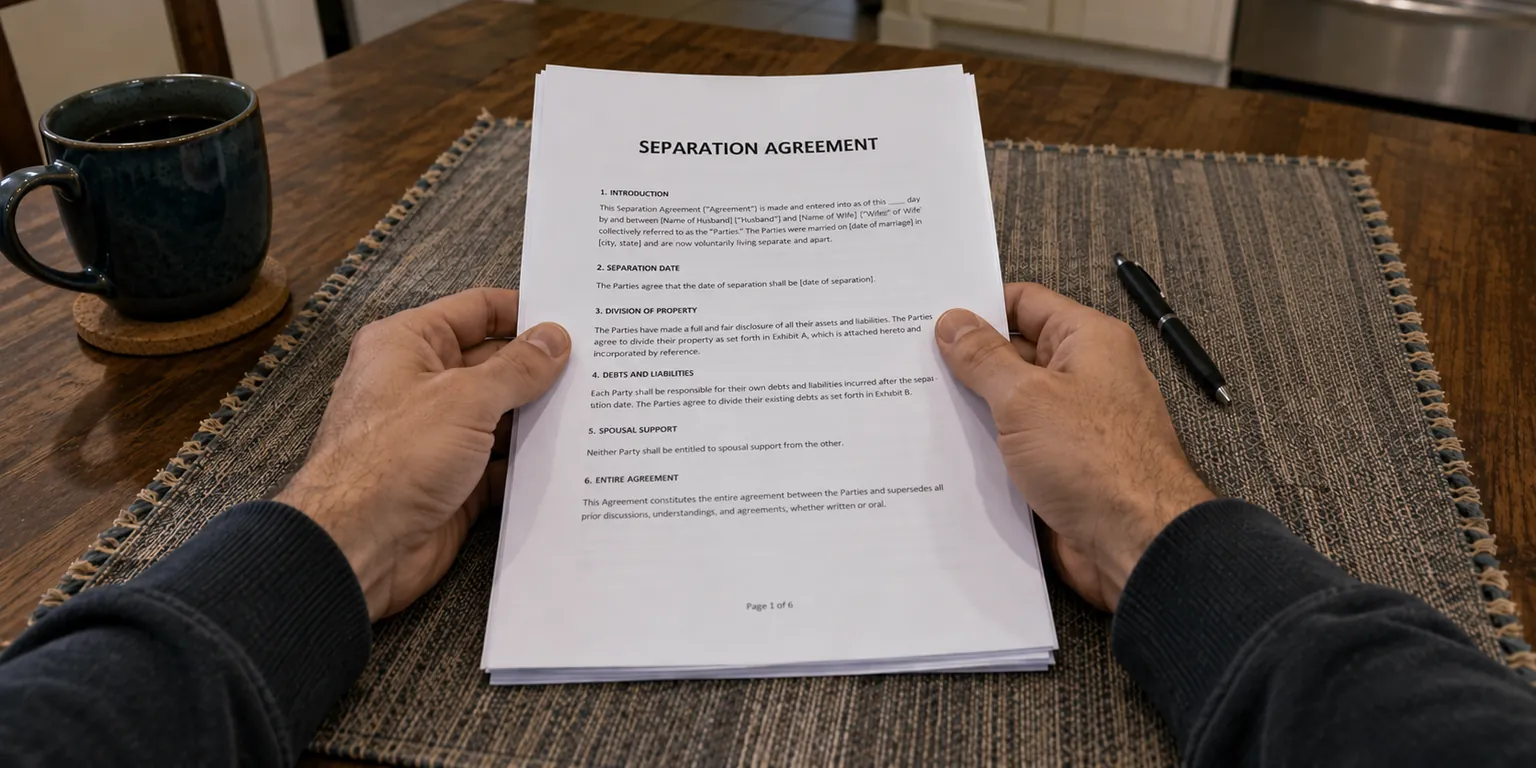
TL;DR. A separation agreement is a written, signed contract between you and your spouse that settles the four things a court would otherwise decide for you — parenting, support, property, and the home. In Ontario, you do not need a court order to separate, and you do not need a lawyer to draft an agreement, but you do need full financial disclosure on both sides and independent legal advice for the agreement to actually hold up later. Done right, you walk out with one document that ends the financial entanglement and tells you what to pay, what you keep, and when.
A separation agreement is the cheapest, fastest, and most private way out of a marriage or common-law relationship in Ontario. The court route averages eighteen to thirty months and costs both sides their savings. A signed agreement settles the same questions in weeks and costs a fraction of that — but only if you know what has to be in it and what makes it enforceable.
What is a separation agreement under Ontario law?
A separation agreement is a "domestic contract" under section 54 of the Family Law Act — a private, binding contract you can ask a court to enforce later. It covers parenting time and decision-making, child support, spousal support, the division of property, what happens to the matrimonial home, debts, pensions, and life-insurance obligations. Anything you and your spouse agree on can go in. Anything that violates the Family Law Act or the Divorce Act — for example, a clause that waives child support owed to a child — will be struck out.
You can sign one whether you are married or in a common-law relationship. The legal rules behind the numbers are different — common-law partners in Ontario do not share equalization of property or automatic matrimonial home rights — but the document itself works the same way. It is a contract, not a court order. You can use it to support filing your taxes as separated, to qualify for separation-based credits like the Canada Child Benefit recalculation, and to back up changes to RRSP beneficiaries, mortgage refinancing, and pension division.
A separation agreement is not the same thing as a divorce. The agreement settles the money and the kids. The divorce ends the marriage. In Ontario you can sign the agreement now and apply for the divorce later — most men do exactly that, because the agreement is what unlocks the practical changes (banking, taxes, refinancing), and the divorce is mostly paperwork once everything else is settled. See our walkthrough of equalization and dividing property in Ontario for how the property side actually gets calculated before it goes into the agreement.
Do you need a separation agreement to be separated in Ontario?
No. You are legally separated the day one of you decides the relationship is over and starts living separate and apart. In Ontario, that can happen under the same roof — many men, especially with kids and a mortgage, separate without anyone moving out for months. You do not file anything. You do not need a judge to declare you separated. The Canada Revenue Agency considers you separated for tax purposes after ninety consecutive days of living separate and apart.
What you need an agreement for is everything that comes after that date. Without one, you have a date of separation but no rules. Your spouse can still write cheques against the joint line of credit. Either of you can refuse to pay the mortgage. There is no enforceable parenting schedule, no support number, and no agreement on who gets the car. The longer you operate without those answers, the more ground the other side gains and the more expensive the eventual fight becomes.
The other reason to sign sooner rather than later: property in Ontario is "frozen" at the date of separation. Bank balances, RRSPs, debts, business value — they're all measured on that day for the equalization calculation. The longer you wait to sign, the more reconstructive accounting both lawyers will do later. The faster you lock down the numbers in a signed agreement, the smaller the bill and the smaller the argument.
What to include in a separation agreement
Five things, in order of how often they cause trouble later:
Parenting. Decision-making responsibility (formerly called "custody") and parenting time (formerly "access"). A real schedule — week-on/week-off, 2-2-3, every-other-weekend — not a vague "as agreed." Holidays, summer, March break, who handles pick-ups and drop-offs, communication rules. The agreement names the residential schedule by week, not by principle. Vague parenting clauses are the single biggest source of separation-agreement litigation in Ontario.
Child support. The table amount under the Federal Child Support Guidelines, based on the payor's gross income and the number of children. Plus the section 7 special-or-extraordinary expenses (childcare, post-secondary, orthodontics, competitive sports) split in proportion to each parent's income. Write the dollar amounts in. Do not write "as per the guidelines" and leave it at that.
Spousal support. Whether anyone pays it, how much, and for how long. The Spousal Support Advisory Guidelines give a low/mid/high range based on incomes, marriage length, and whether children are involved. The agreement should name a specific dollar figure, a payment date, and either a fixed end date or the trigger that ends it (remarriage, retirement, an income threshold). See our spousal support in Ontario guide for how the SSAG numbers actually get to a final figure. Run your child and spousal support numbers free with the Cairn calculator before you negotiate a figure.
Property and debt. For married couples, the equalization payment — the cash transfer that balances out what each spouse owns on the separation date. Every account, every debt, the pension, the business, RRSPs, vehicles. For common-law partners, no automatic equalization — instead, the agreement lists who keeps what and any constructive-trust claims (where one partner built up the other's asset and is owed a share).
The matrimonial home. Who stays, who buys out, how the buy-out is funded, and the deadline. For married couples, both spouses have equal possession rights regardless of whose name is on title — see your rights to the matrimonial home in Ontario. For common-law, ownership follows title.
Optional but smart: a clause naming the date of separation, a release of equalization and support claims once the agreement is signed, and a clause requiring mediation before any future litigation. The agreement should also list the financial disclosure each side relied on — that is what makes it stand up later.
Is a separation agreement legally binding in Ontario?
Yes — when it is written, signed by both of you, and witnessed, it is a binding domestic contract under section 54 of the Family Law Act. What keeps it binding is what happened before signing: full financial disclosure on both sides, and independent legal advice — a short review with your own lawyer — for each of you. A court can set an agreement aside under section 56(4) if assets were hidden, one side did not understand it, or someone signed under pressure. Get those three protections in place and the agreement holds for decades.
How do you actually get one signed?
There are four common paths in Ontario, and they sit on a cost ladder.
| Path | Cost (combined) | Best for |
|---|---|---|
| Kitchen-table + ILA | $1,000–$2,500 | Amicable, simple terms |
| Mediation | $3,000–$8,000 | One or two stuck issues |
| Collaborative family law | $8,000–$25,000 | High-asset or high-conflict, no court |
| Lawyer-led negotiation | $10,000–$50,000+ | One side won't engage |
Kitchen-table agreement, both sides get ILA. You and your spouse agree on the terms yourselves. You each take the draft to your own lawyer for "independent legal advice" — the lawyer reviews it, explains what you are giving up, and signs a certificate. Total cost: $1,000–$2,500 if the terms are not complicated. This is what most amicable Ontario separations look like.
Mediation. A neutral mediator (often a family lawyer or a senior social worker) walks you both through the issues over three to six sessions and drafts the agreement at the end. You still each get ILA. Total cost: $3,000–$8,000 split. Faster than litigation, slower than kitchen-table, but useful when there's one or two issues you cannot agree on alone.
Collaborative family law. Each side has a collaborative-trained lawyer; both lawyers commit in writing not to go to court. Often joined by a financial neutral and a parenting coach. Total cost: $8,000–$25,000 combined. Good for high-asset or high-conflict cases where you still want to settle without a judge.
Lawyer-led negotiation. Each side hires a family lawyer; the lawyers draft and negotiate by letter and email. This is the default if one side will not engage directly. Total cost: $10,000–$50,000+ combined depending on how many drafts it takes. Still cheaper than court — most files settle here.
Whichever path you pick, the agreement has to be in writing, signed by both of you, and witnessed. Each side has to have exchanged sworn financial disclosure (or a Form 13.1 — the financial statement Ontario family courts use; see which family court forms you need). Each side should have independent legal advice. An agreement without disclosure and without ILA is the agreement most likely to get set aside under section 56(4) of the Family Law Act later — and "later" can mean fifteen years from now.
Can you write your own separation agreement?
You can — Ontario law does not require a lawyer — but in practice the do-it-yourself agreement is the riskiest path, because the failure mode is delayed. The template you downloaded does not flag that you forgot to include the pension. The kitchen-table conversation did not mention the LIRA from her 2018 job. You sign it, you both move on, you each remarry. Then in 2031 her lawyer notices the pension was never equalized and applies to set the agreement aside.
Section 56(4) of the Family Law Act lets a court set aside a domestic contract when one party failed to disclose significant assets or debts, did not understand the contract, or signed under duress. "I didn't have a lawyer" by itself is not enough — but "I didn't have a lawyer and I didn't get full disclosure" usually is. The cheap version costs you the entire equalization argument all over again, fifteen years late.
Realistic middle path: build the draft yourself (or in mediation) using a known-good template — Steps to Justice's separation and divorce guide walks through what each section needs to cover. Exchange full sworn financial statements with everything attached. Then each of you takes it to a family lawyer for ILA. The ILA review usually catches the missing pension, the wrong income figure, the clause that accidentally waives child support. The total bill is still low, but the agreement actually survives.
The one thing to do this week
Write down your date of separation and the four lists — assets, debts, income, parenting plan — exactly as they stood on that day. Account numbers, account balances, RRSP statements, the mortgage balance, the pension commuted-value estimate. Until you have that on paper, you are not in a position to sign any agreement, accept any offer, or even read a draft critically. The disclosure is the agreement — the words are just how you write it down.
Where Cairn helps next
A five-minute intake gives you a specific Ontario plan, your support numbers, and the one thing to do this week. Free, no credit card.
- Your specific Ontario plan, free, in five minutes
- The action plan that tells you the next step every week
- Built only for Ontario family law
Frequently asked questions
- What can you not do during a separation in Ontario?
- You should not empty joint accounts, hide assets, change beneficiaries on insurance or RRSPs, or take the children out of the province without the other parent's consent. Anything you do unilaterally between the date of separation and the agreement gets reversed and held against you. Keep paying your share of joint debts, document everything in writing, and do not sign anything your spouse hands you without independent legal advice.
- Can you do your own separation agreement in Ontario?
- Yes, Ontario law does not require a lawyer to draft a separation agreement. The risk is that the agreement gets set aside years later under section 56(4) of the Family Law Act if disclosure was incomplete or one side did not understand what they were signing. The middle path: draft it yourselves, exchange full sworn financial statements, and each of you takes the draft to your own lawyer for independent legal advice before signing.
- What is a wife or common-law partner entitled to in an Ontario separation?
- It depends on whether you were married or common-law. Married spouses share half of what the marriage built through the equalization of net family property, plus possible spousal support based on incomes and length of marriage. Common-law partners do not share property automatically, but spousal support still applies after three years of cohabitation or sooner if there is a child of the relationship. Child support is the same either way.
- How long does a separation agreement take to finalize in Ontario?
- Two to six months is typical when both sides engage. Kitchen-table negotiations with independent legal advice can land in four to six weeks. Mediation usually runs three to five months. Lawyer-led negotiation with disputes can stretch to nine to twelve months. The single biggest accelerator is completing full financial disclosure early.
- Does a separation agreement give you a divorce in Ontario?
- No. A separation agreement settles the money, parenting, and property. A divorce ends the marriage itself and requires a separate court application under the Divorce Act. Most Ontario couples sign the agreement first and apply for the simple divorce a year later, which is when both sides have been living separate and apart for the required twelve months.
- Is a separation agreement legally binding in Ontario?
- Yes - when it is written, signed by both spouses, and witnessed, it is a binding domestic contract under section 54 of the Family Law Act. It holds up best when both sides exchanged full financial disclosure and each got independent legal advice before signing. A court can set it aside under section 56(4) for hidden assets, lack of understanding, or duress.